
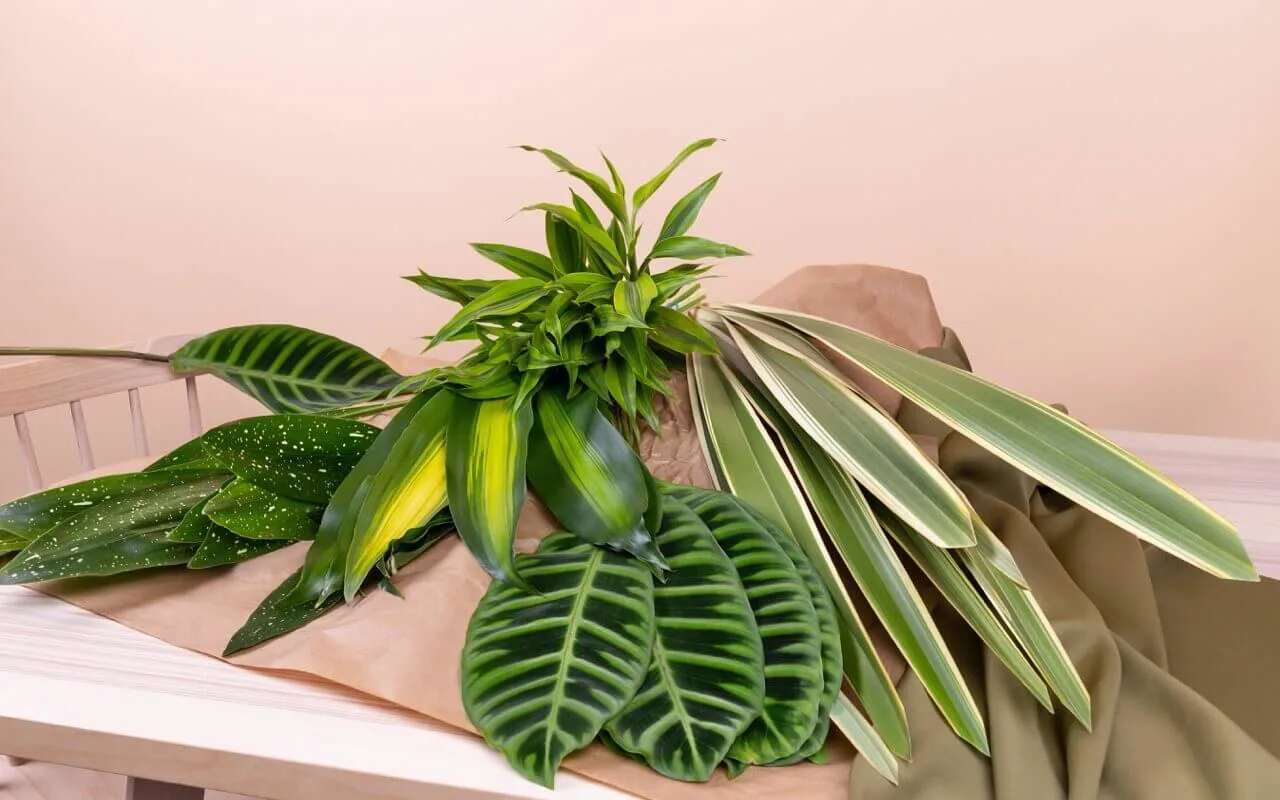
Foliage is so much more than a filler! Just like falling leaves that change with the season, two-toned leaves are a spectacle in our COSY bouquet collection this fall.
There’s nothing more satisfying than sunlight illuminating russet-orange leaves on a fall walk in the woods. As an ode to the cosiest season, we’re mirroring foliage that goes from green to red to gold with an abundance of variegated leaves and flowers taking centre stage in our bouquets.
Trust us; variegated houseplants and foliage in bouquets is the next big trend! Here are the bi-coloured plants to fall for this autumn.
“Autumn is a second spring, when every leaf is a flower”
— Albert Camus, Le Malentendu
Twice the beauty, double the fun
Whether blotched, striped, bordered, or speckled, ‘variegated’ is the term to describe flowers and foliage that have two or more colours. Bi-coloured leaves are a thing of beauty and add as much interest to your garden or bouquet as flowers!
What causes variegation?
Unlike fall leaves that change colour due to a lack of chlorophyll when the tree has to absorb more energy in the waning sun, variegation can be the result of a mutation that breeders found and developed. Some plants, like (painted nettle), grow more variegated leaves in brighter environments and less multicoloured in darker ones. Pigmented variegation is a way in which a plant adapts to its environment. Clever!
Aspidistra
The starry smattering on ‘Milky Way’ is out of this world! As a houseplant, aspidistra earned itself the name ‘cast iron plant’, because of its indestructible nature. The winter chill and not-so-green-thumbed owners who forget to water it (oops) are no match. In a bouquet, aspidistra is distinct because of its height and unusual variegation. It looks astronomical against fall coloured flowers, too.
Carex ‘Sparkler’
If you’re looking for a pop of pattern, look out for ‘Sparkler’ in your bloomon bouquet this fall. Its striking cream-green variegated leaves grow in whorls, making it look like sparks bursting from the stem. Stunning in every season; we even used carex in our flower crowns this summer!
Calathea
Take a walk on the wild side with exotic Calathea ‘Zebrina’. A plant that’s twice as fun, if you can believe it! Not only does the vibrant variegation on the top look stunning in a bouquet, but its flip side is fabulous, too. Varieties like (rattlesnake plant) are seriously trending as a houseplant because the bright, two-toned pattern is contrasted by a deep purple underside.
Brassica
Perhaps not your first thought for a flower arrangement, but ornamental cabbage is beautiful in a bouquet — largely due to the incredible variegation. Swirls and splatters in shades of green, cream, and indigo make brassica the trendiest in the Brassicaceae family. Well, you wouldn’t put just any old cabbage, broccoli, or kale in a bouquet, would you?
Cordyline
Known as the cabbage palm — no relation to brassica or a palm, it’s actually in the asparagus family — a cordyline branch adds drama and a hint of Tropicana to an arrangement. And, if the two-toned leaves alone haven’t left you falling for it, it’s also said to bring good luck. Good things come to those with a cordyline ‘Yellow Tops’ in their COSY bouquet!
Fittonia
Whilst you won’t find fittonia in our bouquets (it’s tiny!), it was one of the plants we used in our terrarium DIY , along with candy-pink, polka-dotted hypoestes. is known as the mosaic or nerve plant, because of its bright and intricate vein pattern. As its native to the tropical rainforests in South America, fittonia is ideal for terrariums and also makes a good houseplant. Just keep it warm and well-watered!
#bloomon
We always love to hear from you! Share photos of your bouquet with variegated flowers and foliage on Facebook and on Instagram using .